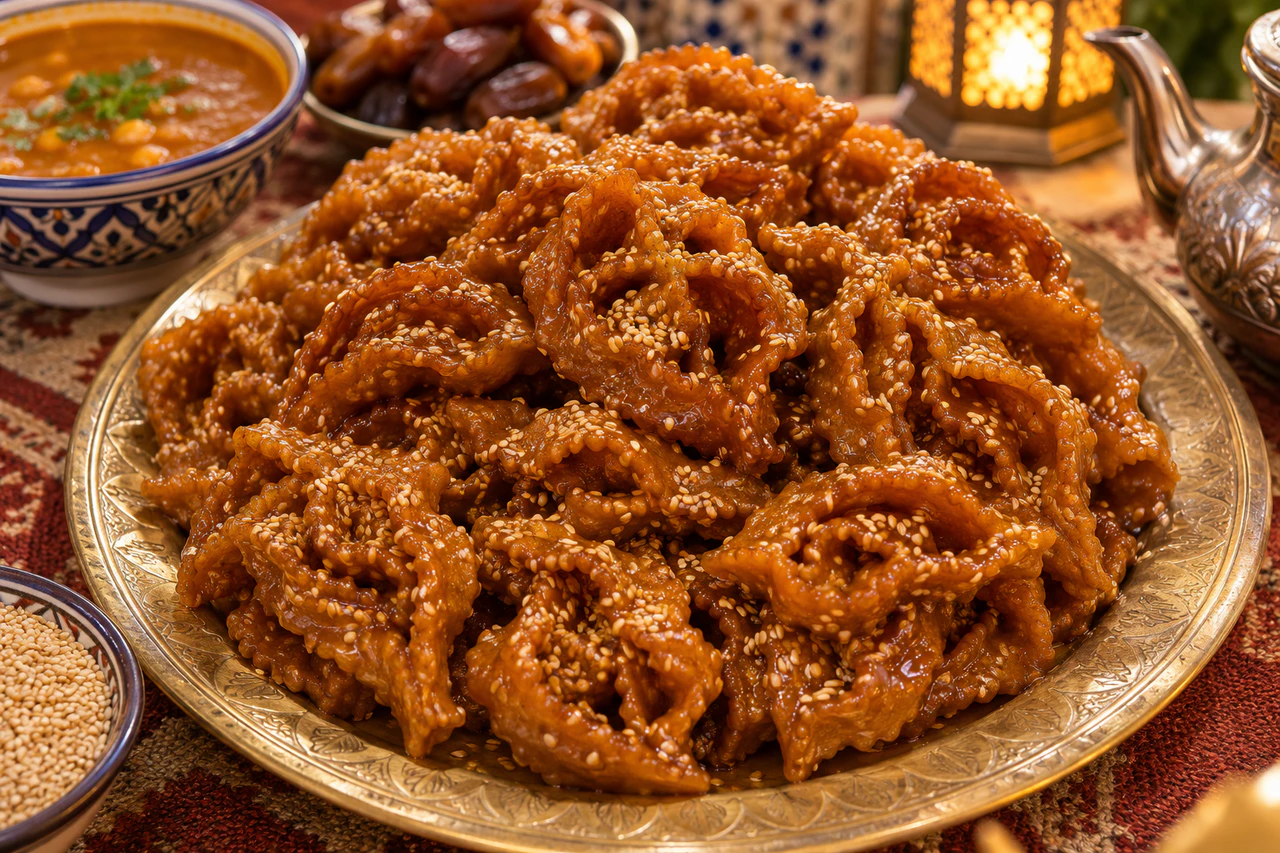
Chebakia, fried and soaked in honey with sesame, the sweet of Ramadan. AI-generated image.
Chebakia: how to make Morocco’s sesame and honey Ramadan sweet
Step-by-step chebakia recipe: dough with toasted sesame and spices, how to shape the flower, frying and soaking in orange-blossom honey. Keeps for a month.
Chebakia — also called halwa chebakia, griouech or mkharka — is a fried, flower-shaped pastry soaked in honey and covered in sesame. It is the sweet most closely tied to Ramadan and celebrations, and it often accompanies harira when the fast is broken. It tastes of toasted sesame, anise, cinnamon, saffron and orange blossom water. This recipe follows Christine Benlafquih’s at Taste of Maroc, who learned it from her sister-in-law.
Makes: about 65 medium pieces, around 2 kg. Time: about 3 hours in all: 30 minutes to toast the sesame, 1 h 30 min of preparation and 1 hour of frying. Equipment: food processor, rolling pin, fluted pastry wheel, deep frying pan, large pot and strainer.
Ingredients
For the dough:
- 200 g unhulled sesame seeds, toasted.
- 500 g plain flour.
- ½ teaspoon each of baking powder and salt.
- 1½ teaspoons each of ground aniseed and ground cinnamon.
- ½ teaspoon saffron threads, ground to a powder.
- ½ teaspoon turmeric.
- 1 pinch gum arabic or mastic, ground with ¼ teaspoon sugar.
- 1 large egg.
- 60 ml melted unsalted butter, 60 ml olive oil, 60 ml vinegar and 60 ml orange blossom water.
- 1 teaspoon dried baker’s yeast dissolved in 60 ml warm water.
For frying and soaking:
- About 1 kg honey.
- 2 tablespoons orange blossom water.
- About 1.4 litres vegetable oil for frying.
- 70 g unhulled sesame seeds, toasted, to decorate.
The original recipe uses cups and ounces; the amounts here are converted to grams and millilitres and rounded.
How to make chebakia
Toast and grind the sesame
Pick through the sesame and toast it until golden: in a heavy pan over medium heat, or on a tray in the oven at 200 °C (180 °C fan) / gas mark 6 for 10–15 minutes. Let it cool completely. Grind the 200 g for the dough in the food processor until powdery, then keep going a little longer, until it packs together when pressed.
The dough
In a large bowl, mix the ground sesame with the flour, baking powder, salt and spices. Add the dissolved yeast and the other liquids and mix by hand into a dough that is firm but pliable, like modelling clay: stiffer than bread dough. If it is dry, add a little orange blossom water; if it sticks, a little flour.
Knead for 7–8 minutes by hand (or 4–5 with a dough hook). Divide into four portions, shape each into a smooth ball and leave them to rest in a plastic bag for 10–15 minutes.
Shaping the flower
Lightly flour the worktop and roll out one portion to the thickness of thin cardboard. With the fluted wheel, cut rectangles about the size of your palm. In each one make four cuts along the length of each rectangle, stopping short of the ends: you are left with five joined strips.
Thread the middle finger of your right hand through every other strip. With your left hand, pinch the two bottom corners to form the centre, let the strips slide off your finger and turn them inside out around the pinched centre. Pinch the opposite ends together: you get an elongated flower. Place the pieces on a tray, covered with a cloth. The scraps are gathered, rested in the bag and rolled out again. Taste of Maroc
Frying and soaking in honey
Heat 2–3 cm of oil in the pan over medium-low heat. In the pot, heat the honey until it is almost boiling and frothy, without bubbling; add the orange blossom water and turn off the heat. Set a sieve over a bowl and keep it nearby.
Fry in batches until medium brown, about 10 minutes per batch. If the oil is too hot, they brown outside and stay raw inside.
With a slotted spoon, move them straight from the oil into the hot honey, push them under gently and leave them for 5–7 minutes, until glossy and amber. Drain them briefly in the strainer and, while still hot, set them on a platter and sprinkle the centres with sesame. If the honey cools and thickens, warm it a little over medium-low heat, even with chebakia in it.
How to shape chebakia flowers
Work with one portion of rested dough at a time and keep the rest in the bag. For the first flower, follow Taste of Maroc’s four folding photographs as you go.
- Roll and cut. Lightly flour the worktop and roll the dough to the thickness of thin card. Use a fluted pastry wheel to cut a palm-sized rectangle. Make four evenly spaced cuts along its length, stopping short of both ends. You should have five strips held together at both ends.
- Lift alternate strips. Count the strips from one long edge to the other. Weave your right middle finger through the cuts so strips 1, 3 and 5 lie over your finger and strips 2 and 4 hang below it.
- Pinch the centre. With your left thumb and forefinger, bring together the two outer corners hanging below your right fingertip. Keep hold of this pinch. It will become the centre of the flower.
- Turn the flower out. Keeping the corners pinched, let the strips slide off your right finger. As they slide, gently turn them inside out around the pinched dough. Pinch the opposite corners together to finish. Look for an elongated flower with distinct loops of dough around the centre.
- Cover as you go. Put the flower on a tray and cover it with a clean tea towel until you’re ready to fry. Gather the trimmings into a ball and let them rest in the bag before rolling them out again.
Adapted from Christine Benlafquih’s illustrated chebakia recipe at Taste of Maroc.
Tips
- Crumbly dough: knead or rest it a little longer, or weigh the flour rather than measuring it by volume.
- Very warm kitchen: use only ½ teaspoon of baker’s yeast, or they will puff up too much.
- Time in the honey: longer makes them sweeter and less crisp; too short leaves them pale and dull. It is a matter of taste.
- Practise the flower: the shape takes a few tries; the author suggests practising with modelling clay first.
How to store them
Let them cool for several hours before sealing them in an airtight container. At room temperature they keep for a month or more, and frozen, 4–5 months. Serve them with harira, mint tea or as a festive sweet.
For cooks in the UK
- Where to buy — Whole Food Earth lists unhulled sesame seeds. You’ll need 270 g in total here, with 200 g for the dough and 70 g for the finish. Seasoned Pioneers lists whole aniseed, which you can grind for the dough. Waitrose lists Nielsen-Massey Orange Blossom Water and Cooks’ Ingredients Saffron. Product pages checked 22 November 2026. Sesame seeds · Whole aniseed · Orange blossom water · Saffron
- For the dough — If you’re using the recipe’s mastic option, Sous Chef lists gum mastic crystals. Crush a pinch with the ¼ teaspoon of sugar called for in the recipe before mixing it into the dough. Product page checked 22 November 2026. Sous Chef · Taste of Maroc