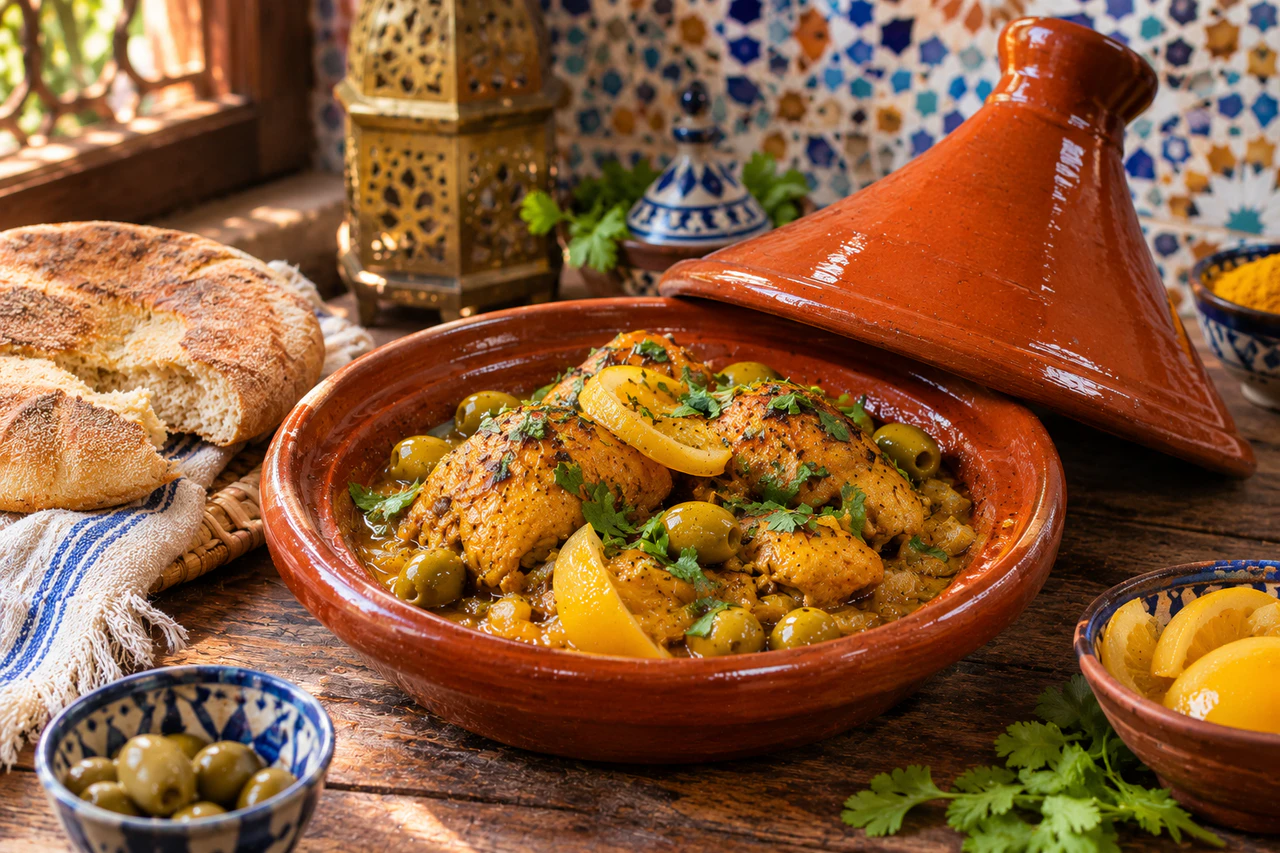
A tagine with its cone-shaped lid lifted, served with khobz, the round Moroccan bread. AI-generated image.
Moroccan tagine: the complete guide to the pot, the dish and cooking it at home
Discover what a Moroccan tagine is, how to use a clay pot safely, and how to cook traditional tagine dishes in a British kitchen, even without the pot.
In Morocco, the word tagine means both a cooking pot and the dish made in it. Here’s how to use one in a British kitchen, how to make a tagine in a casserole dish and six traditional Moroccan tagines to try.
What is a tagine?
The pot. A tagine has a round, shallow base and a tall, cone-shaped or domed lid. As the food cooks, steam condenses inside the lid and drips back into the dish. Traditional pots are made of plain or glazed clay. You’ll also find flameproof ceramic tagines and models with a cast-iron base.
The dish. A tagine is a gently cooked stew of meat, poultry, fish or vegetables. The seasonings vary with the dish. Preserved lemon and green olives give a chicken tagine its salty, tangy sauce, while prunes bring sweetness to a lamb tagine.
The word. Tagine, also spelt tajine, comes from the Arabic ṭajīn, which goes back to an ancient Greek word for a shallow clay pan. According to Wikipedia, the cone-lidded tagine is thought to have originated in Tafraout, in southern Morocco.
How tagine is cooked in Morocco
Traditionally, a tagine cooks slowly over charcoal on a small clay brazier known as a kanun or majmar. Today, many Moroccan homes use a gas hob on a low flame.
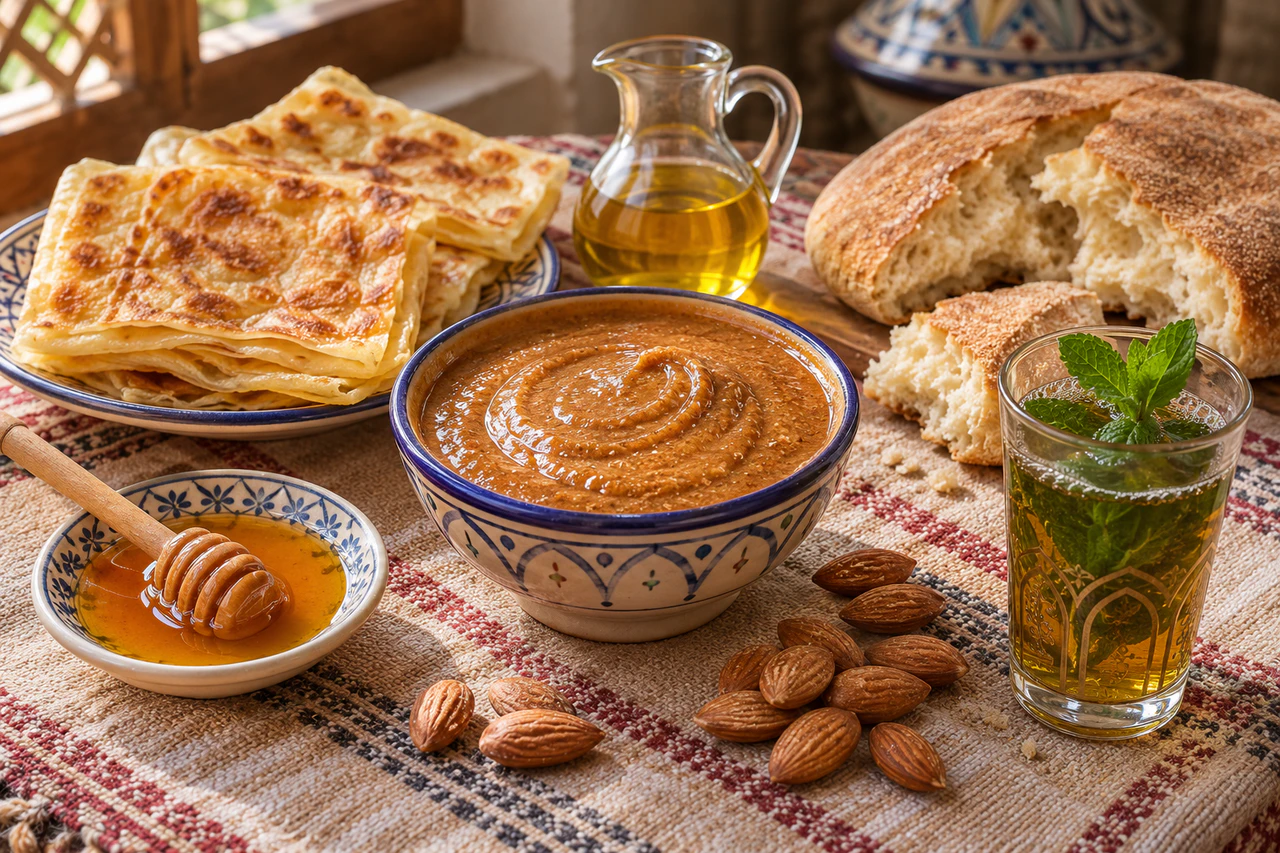
At the table, we often serve the tagine in its pot and share it, using pieces of khobz, the round everyday loaf, to scoop up the food with the right hand. In many Moroccan homes, couscous is a Friday dish in its own right. If you’d like to make msemen to go with your tagine, it works well for scooping up the sauce too.
Which tagine do you have?
Check what your tagine was made for before heating it, especially if you bought it on holiday.
- Decorative tagine. Many brightly painted souvenir tagines are made for serving or display. Only put one over heat if you can confirm it was made for cooking.
- Clay cooking tagine. This is plain or glazed earthenware made for cooking over heat. Clay tagines are still part of Moroccan home cooking. They need gentle heat, and some need seasoning before their first use.
- Modern ceramic tagine. Emile Henry’s Flame tagine works on gas, electric and halogen hobs and in the oven. For induction, the maker’s Delight tagine works on all hob types and in the oven. The Flame model is unsuitable for induction. (Flame specifications, Delight specifications.)
- Cast-iron base. Le Creuset’s tagine has a cast-iron base and a stoneware lid. The base works on all hobs, including induction, and is oven-safe. (Le Creuset’s tagine guide.)
Can you use a tagine on a British hob?
| Heat source | Clay cooking tagine | What to do |
|---|---|---|
| Gas | Yes, if the pot is made for hob use | Use the lowest flame with a heat diffuser between the flame and the pot. |
| Electric or ceramic | Usually, with care | Check the instructions for both the pot and the hob. If they allow a diffuser, use it on the lowest setting. |
| Induction | No. Plain clay doesn’t work on induction. | Use an induction-compatible tagine with a cast-iron base or a ceramic model sold for induction. An induction-compatible casserole dish also works. |
| Oven | Usually — check your pot’s instructions; put it in a cold oven | Let the pot warm up with the oven. |
Avoid sudden changes of temperature with clay. Start over low heat with the ingredients already in the base, and keep the hot pot away from cold water and cold worktops.
How to season a new clay tagine
Check whether your pot needs seasoning and follow the maker’s first-use instructions if you have them. For a plain clay cooking tagine that needs seasoning and came without instructions, Moroccan Zest gives this method.
- Soak the base and lid in water for at least 2 hours, preferably overnight.
- Drain both pieces and let them air-dry.
- Brush the base and lid, inside and out, with 1–3 tbsp of olive oil in total, depending on the size of the pot.
- Put the tagine in a cold oven. Set it to 150°C (130°C fan) / gas mark 2 and leave it for a couple of hours.
- Switch off the oven and let the tagine cool completely inside.
- Brush the inside of the base and lid with a little more olive oil and leave it to soak in for at least an hour.
Season the pot once, before its first use.
Caring for a clay tagine
Follow the maker’s care instructions if you have them. As a general rule, let the tagine cool completely, then wash it by hand in warm water and keep it out of the dishwasher. Dry the base and lid thoroughly before putting them away. Store the pot with the lid off or slightly ajar so moisture can escape. (Clay tagine care.)
How to cook in a tagine
Clay tagines are made for gentle cooking. Each of our linked recipes gives its own amounts and cooking times.
- Start with the base. In many tagines, olive oil and sliced onions go in first. Some recipes brown the meat first.
- Layer the ingredients. Follow your recipe for when to add the meat or fish, spices, garlic and vegetables.
- Add the recipe’s liquid. If the recipe calls for water, add only the small amount it gives. The covered pot keeps the moisture in.
- Cook gently with the lid on. Bring the tagine up to a gentle simmer over low heat. Use a diffuser if your pot and hob call for one.
- Check occasionally, without stirring. Lift the lid only when you need to check the sauce or see how the food is cooking.
- Check the chicken before serving. Cut into the thickest part. The meat should be steaming hot all the way through, with no pink meat, and the juices should run clear. (Food Standards Agency.)
- Serve from the pot. Put bread on the table for scooping up the sauce.
How to make a tagine without a tagine
- On the hob. Use a wide, heavy-based pan or casserole dish with a tight-fitting lid. For her chicken tagine, Felicity Cloake keeps it at a very gentle simmer for about 45 minutes. If the lid fits loosely, she puts foil over the pan before fitting the lid. (The Guardian’s chicken tagine.)
- In the oven. Use a lidded ovenproof casserole dish and follow a tagine recipe written for oven cooking.
- In a slow cooker. Choose a recipe written for a slow cooker so the amount of liquid suits the method.
Six traditional Moroccan tagines to try
- Chicken with preserved lemon and olives. A good place to start, with ginger, green olives and the salty tang of preserved lemon.
- Lamb with prunes and almonds. Lamb cooked with saffron and ginger, served with sweet prunes, almonds and sesame.
- Kefta with eggs. Spiced meatballs simmered in tomato sauce, with eggs cracked into the sauce towards the end.
- Beef with peas and artichokes. A tagine to make when peas and artichokes are in season.
- Berber vegetable tagine. Vegetables stacked in a pyramid with preserved lemon and olives.
- Agadir fish tagine. Fish marinated in chermoula before cooking. For places to try fish tagine on the northern coast, see our guides to Tangier and Tetouan.
A related Moroccan dish is tanjia, cooked in a different clay vessel. The Marrakech version pairs beef with preserved lemon and cumin.
Spices in a tagine
The seasoning depends on what’s in the pot. Ginger goes with chicken and preserved lemon, saffron and ginger season lamb with prunes, and cumin and paprika give fish chermoula its flavour. Fresh parsley and coriander also appear in tagine recipes.
Ras el hanout is a Moroccan spice blend used in some tagines, including our lamb with prunes. Follow the blend of spices in the recipe you’re making. Chilli is optional.
Common mistakes
- Turning the heat up too quickly. Bring the pot up to temperature gradually to avoid cracking the clay.
- Adding too much water. Use the amount in your recipe. Steam collects under the lid and drips back into the sauce.
- Lifting the lid too often. Check occasionally so you keep the steam in the pot.
- Using a clay tagine on induction. Choose a vessel specifically rated for induction.
- Cooking in a souvenir tagine. Use it for serving if you can’t confirm it was made for cooking.
- Using the same cooking time for every tagine. Follow the recipe for the meat, fish or vegetables you’re cooking.
Frequently asked questions
Is a tagine the pot or the dish?
Both. The word means the pot with the tall lid and the dish cooked in it.
Do I need a tagine pot?
A heavy-based casserole dish with a tight-fitting lid works well.
Can I use a tagine on an induction hob?
Choose a model explicitly rated for induction, such as a suitable cast-iron-based tagine or an induction-compatible ceramic model. Plain clay won’t work.
Do I need a heat diffuser?
Use one with a traditional clay cooking tagine on gas. On an electric or ceramic hob, check the instructions for both the tagine and the hob.
Can a tagine go in the oven?
Check the maker’s instructions. If your clay tagine is oven-safe, put it in a cold oven and let the two heat up together.
What is tagine served with in Morocco?
We usually eat it with bread to scoop up the sauce. Couscous is a dish in its own right and is often served on Fridays.
Is Moroccan tagine spicy?
The seasoning depends on the recipe. Ginger, saffron and cumin bring plenty of flavour, and chilli is optional.
Sources: Wikipedia, “Tajine”; Moroccan Zest, tagine seasoning; Big Horn Olive Oil, clay tagine care; Emile Henry Flame; Emile Henry Delight; Le Creuset UK, tagine guide; The Guardian, “How to make chicken tagine”; Food Standards Agency, “Cooking your food”.