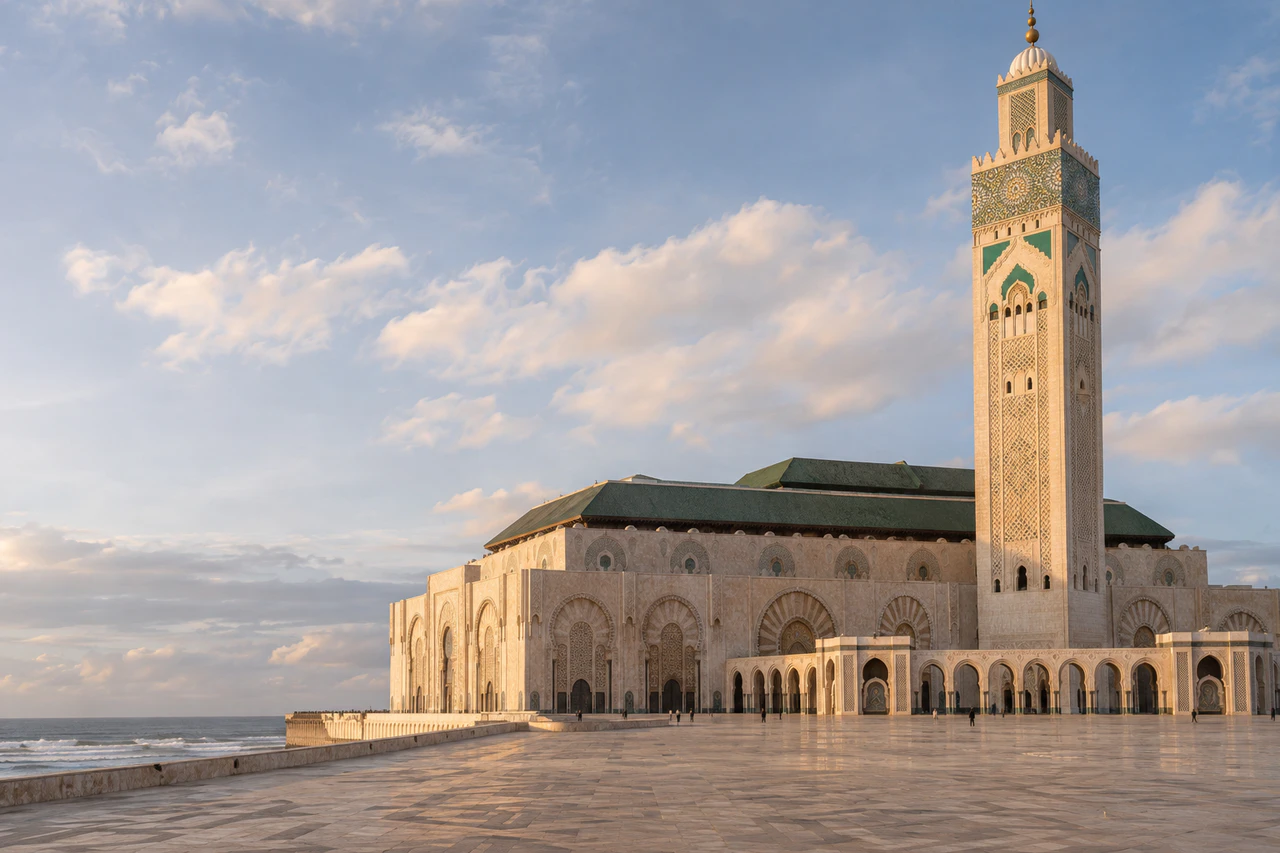
The Hassan II Mosque and its esplanade facing the Atlantic in the late afternoon. AI-generated image.
Things to do in Casablanca: from the Hassan II Mosque to Art Deco and the Corniche
A first-timer's guide to Casablanca: the Hassan II Mosque, the Habous quarter, the Art Deco centre, Notre-Dame de Lourdes, the Museum of Moroccan Judaism and the Corniche, with tips on getting there and getting around.
Casablanca looks nothing like Fez or Marrakech, and that is exactly why it is worth a visit. It is Morocco’s largest city and its economic engine: within a few streets you go from one of the biggest mosques in the world to 1930s Art Deco boulevards and a neighbourhood built to look like a traditional medina. This guide covers the essentials for one or two days, along with the practical details worth checking before you go.
The Hassan II Mosque
This is the visit that makes the trip. It stands right on the Atlantic and is one of the very few mosques in Morocco that non-Muslims can visit. Entry is by guided tour only, at several times a day except during Friday prayers; during Ramadan and the Eid holidays the times change or tours are suspended.
Prices and tour slots vary through the year, so the most reliable option is to check them on the website of the Hassan II Mosque Foundation before you go. Wear clothes that cover your shoulders and knees, and women should bring a scarf to cover their hair. Even if you don’t go inside, the esplanade facing the sea is worth a stroll, especially in the late afternoon.
The Habous quarter
Also known as the New Medina, it was built under the French protectorate, mainly in the 1920s and 1930s, with an unusual idea: a neighbourhood with the look of a traditional medina but with planned streets and modern services. Today it is a pleasant place to wander without the crowds, among arcades, small squares, religious bookshops, craft shops and olive sellers.
Next to it are the Royal Palace (not open to visitors) and the Mahkama du Pacha, the former residence and court of the pasha, from the mid-20th century; sources disagree on the exact dates of its construction. If you have a sweet tooth, the quarter is home to well-known traditional pastry shops: we cover them in Casablanca’s sweets: Moroccan pastries in the Habous.
The Art Deco centre
Casablanca grew very fast in the first half of the 20th century, and that period left it with one of the most interesting collections of Art Deco architecture in Africa. The best walk is along Boulevard Mohammed V, with its geometric façades, balconies and Moroccan-inspired details, as far as Mohammed V Square, surrounded by 1930s public buildings.
Nearby is the former Sacré-Cœur, designed by the architect Paul Tournon, begun in 1930 and finished in the early 1950s. Although it is called a cathedral, it was never the seat of a bishop; it stopped being a church after independence in 1956 and is now a cultural venue. The Casamémoire association, which has been protecting this heritage since the 1990s, holds open days every year: if they coincide with your trip, they are the best way to get inside buildings that are normally closed.
Notre-Dame de Lourdes
A modern 1950s church by the architect Achille Dangleterre, visited mainly for its stained-glass windows by the Chartres master glazier Gabriel Loire. When the sun comes in, the interior fills with colour. It is a working place of worship: go in quietly and respect the times of Mass.
The Museum of Moroccan Judaism
In the Oasis district, in a 1948 villa that was once an orphanage, this museum opened in 1997 tells the long history of Morocco’s Jewish communities through religious objects, costumes, jewellery and photographs of synagogues. For years it was described as the only Jewish museum in the Arab world. It sometimes closes without notice, so it is best to call ahead.
The Corniche and the islet of Sidi Abderrahmane
West of the centre, the Corniche at Aïn Diab is where Casablanca goes to walk by the sea: beaches, cafés and plenty of people at sunset, especially at weekends. At the far end you can see the islet of Sidi Abderrahmane, with the shrine of a Sufi saint. It used to be reachable on foot only at low tide; today a small bridge links it to the shore. The islet was restored and reopened in 2024; check the opening times on site.
What to eat in Casablanca
Casablanca is a fish city: start at the Central Market, then have grilled or fried fish. We explain how in What to eat in Casablanca, and we also cover the city’s seafood pastilla and chicken tagine with preserved lemon.
Getting there and getting around
- From Mohammed V Airport: an ONCF train runs to the city centre. On the ONCF website the airport station is listed as “Aéroport Mohammed V”.
- By train from other cities: the main station is Casa-Voyageurs. The Al Boraq high-speed train leaves from there for Rabat and Tangier; the journey to Tangier takes about two hours.
- Around the city: the tram connects the main districts with the centre; for the Corniche and the mosque, a taxi is the easiest option.
Before you go
- The Hassan II Mosque’s tour times and prices change: check them on its official website.
- Dress modestly at religious sites.
- One day is enough for the mosque, the Art Deco centre and the Habous; with two, add the museum, Notre-Dame de Lourdes and the Corniche at sunset.
Tips for British visitors
- Getting there from the UK. Royal Air Maroc flies direct to Casablanca Mohammed V Airport (CMN) from London Heathrow, Gatwick, Stansted and Manchester. Routes checked on 22 November 2026. Routes and timetables change, so check your travel dates before booking. Heathrow · Gatwick · Stansted · Manchester
- When to go. For a trip built around walking, National Geographic recommends April, May, September or October. If you want to join a guided architecture walk, check Casamémoire’s programme before settling on dates. National Geographic · Casamémoire
- Cash and Ramadan. Keep some Moroccan dirhams for small taxis, street stalls and tips. During Ramadan, check restaurant opening hours and avoid eating or drinking in public during daylight. Lonely Planet · GOV.UK
WORDING FIXES
| Exact phrase | Suggested wording |
|---|---|
| “its economic engine” | “its commercial centre” |
| “This is the visit that makes the trip.” | “If you only have time for one sight, make it the Hassan II Mosque.” |
| “this museum opened in 1997 tells” | “this museum, which opened in 1997, tells” |
| “where Casablanca goes to walk by the sea” | “where locals come for a walk by the sea” |
OUTDATED OR TO CHECK
- Hassan II Mosque. Update the guided-tour link. The Foundation gives separate Friday and Ramadan schedules. Its published dress rules specify clothing covering the shoulders and torso and falling below the knees. They also require visitors to remove their shoes and give no headscarf requirement. Check Eid arrangements directly and remove the scarf instruction unless the Foundation confirms it. Hassan II Mosque Foundation
- Mahkama du Pacha, Sacré-Cœur and Notre-Dame de Lourdes. Confirm visitor access to the Mahkama, the Sacré-Cœur exhibition programme and the church’s visiting and Mass times. Verify the Sacré-Cœur construction dates, the claim about the bishop’s seat and the dating of the buildings around Mohammed V Square before retaining those details.
- Casamémoire. Guided heritage visits are confirmed. Check the dates and participating buildings for the next edition before promising access to any particular interior. Casamémoire
- Museum of Moroccan Judaism. The museum publishes opening hours. Link to them and advise calling ahead for holiday changes. The claim that the museum closes without notice could not be verified. Museum contact and hours
- Sidi Abderrahmane. Confirm current bridge access, visiting hours and any restrictions at the shrine. The 2024 reopening does not establish today’s arrangements.
- Transport. ONCF lists the airport service via Casa-Voyageurs to Casa-Port. Check the last train, the Al Boraq journey time for the chosen departure and the current tram options for the Corniche before giving a firm recommendation. ONCF airport timetable
Sources: Hassan II Mosque Foundation; Lonely Planet: Habous quarter and Museum of Moroccan Judaism; Medias24 on the Sacré-Cœur; Atlas Obscura on Casamémoire; Wikipedia: Notre-Dame de Lourdes Church (Casablanca); Medias24 on the islet of Sidi Abderrahmane; Lonely Planet: Morocco’s train routes.