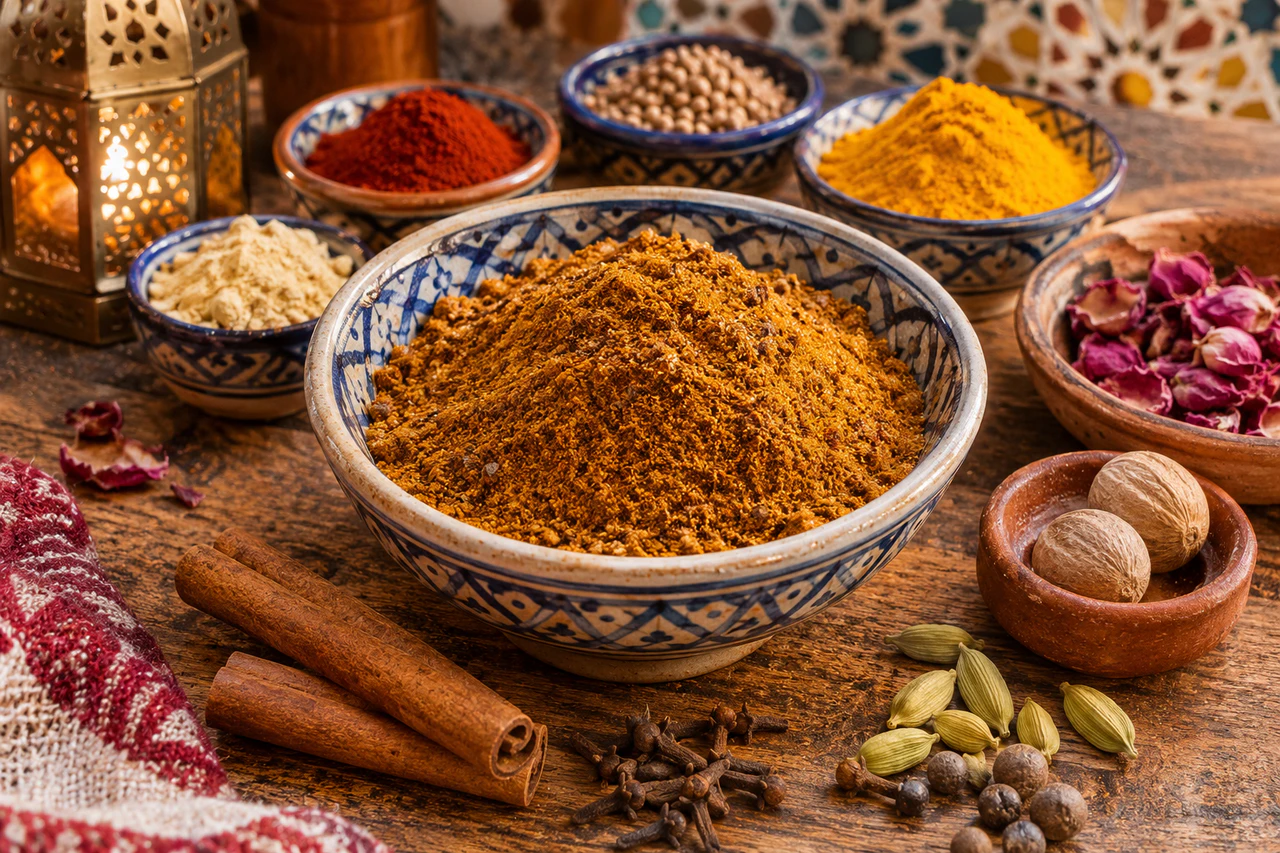
Ground ras el hanout surrounded by some of the spices that can go into it. AI-generated image.
Ras el hanout: what it is, what's in it and how to use it
Learn what goes into ras el hanout, why blends vary and how to use it in Moroccan cooking. Follow a Fez-style recipe or see what to look for on a UK label.
Ras el hanout is a Moroccan spice blend, not a single spice. The name literally means “head of the shop” — according to Taste of Maroc, the best a spice seller has to offer. Recipes vary from one attar (spice seller) to another, so there is no single definitive mixture.
What does ras el hanout taste like?
Ras el hanout is warm, fragrant and often slightly floral. Depending on the blend, you may notice the sweetness of cinnamon, the warmth of ginger, the fragrance of cardamom or the floral notes of dried rosebuds.
Some mixtures contain more pepper or chilli than others, so ras el hanout is not necessarily hot, even if it has a peppery warmth. A blend from Fez may taste quite different from one bought in Marrakech or a British supermarket. That variation is part of the tradition.
What spices are in ras el hanout?
There is no universal ingredient list. According to Taste of Maroc’s guide to a Fez-style ras el hanout, a full traditional mixture can contain between 25 and 40 spices, while a simpler version to make at home may use around 10.
Taste of Maroc’s recipe from a Fez spice seller includes these spices, among others:
- Galangal
- Nutmeg and mace
- Turmeric
- Cinnamon
- Long pepper, cubeb, white and black pepper
- Dried rosebuds
- Dried ginger
- Green cardamom
- Cloves
- Allspice
- Lavender
- Star anise
This is one example of a blend from Fez.
Does ras el hanout contain cumin?
Not always. Taste of Maroc’s Fez blend contains neither cumin nor fenugreek. Both appear in blends from other regions. So two jars labelled “ras el hanout” can contain quite different ingredients and still both belong to the Moroccan tradition.
Which ingredients are common, and which vary?
| Spices | What to know |
|---|---|
| Ginger, cinnamon and pepper | Familiar warming spices in many ras el hanout recipes |
| Cardamom, cloves and nutmeg | Fragrant spices in the documented Fez mixture |
| Rosebuds and lavender | Floral ingredients that give some blends their distinctive aroma |
| Mace, galangal, cubeb and long pepper | Less familiar spices in the Fez blend |
| Cumin and fenugreek | In some regional blends, but not in the Fez mixture |
| Turmeric and star anise | In the Fez mixture, but not in every version |
Ras el hanout in Morocco: the spice seller’s blend
In Morocco, people buy ras el hanout from the spice seller in the medina. Spice sellers make their own blends, each with its own flavour; Taste of Maroc notes that families buy from a seller they trust, and other households make their own.
For more on local cooking, see our guides to what to eat in Fez and what to eat in Marrakech.
How to make ras el hanout at home
Open Taste of Maroc’s Fez-style recipe before you start: it gives the full ingredients, quantities, oven setting and timings, and which spices are toasted and which are added later.
An overview of its method:
- Toast the whole spices in the oven, as the recipe explains.
- Let them cool completely.
- Grind the toasted spices coarsely, in a spice or coffee grinder.
- Add the remaining ingredients given in the recipe.
- Grind again until fine.
- Sift the blend through a sieve and keep the fine powder.
- Store it in a sealed glass jar, away from light.
You don’t need every traditional spice. Cardamom, nutmeg and cloves are easy to find in Britain; cubeb and long pepper may be harder to find. If you can’t get them, one of the ready-ground blends below is a good option.
Where to buy ras el hanout in the UK
If you’d rather not grind your own, we found these ready-ground blends listed online on 22 November 2026:
| Supermarket | Product | Pack size |
|---|---|---|
| Waitrose | Cooks’ Ingredients Ras el Hanout | 50 g |
| Sainsbury’s | Ras el Hanout, Inspired to Cook | 45 g |
| Tesco | Schwartz Ras El Hanout | 38 g |
Check the retailer’s listing or your local shop for availability: stock and packaging change.
What to look for on the label
- Dry blend or paste: a powdered spice mixture and a prepared paste are different products.
- Salt and sugar: some prepared blends contain them, which affects how you season the dish.
- Chilli: check the ingredients for chilli if you prefer a milder blend.
- The spices themselves: compare the list with the flavour you want, especially if you’re after a floral blend.
A supermarket blend is useful for everyday cooking, but don’t expect it to taste exactly like a Moroccan spice merchant’s.
How to use ras el hanout in Moroccan cooking
You’ll find ras el hanout in dishes such as mrouzia and chicken rfissa, and some tagines use it too — but not every Moroccan tagine contains it. Many Moroccan recipes use single spices such as ginger, saffron, turmeric, cumin or cinnamon instead.
Our recipes that use it:
- Lamb tagine with prunes and almonds — the recipe uses a teaspoon of ras el hanout alongside saffron, ginger and cumin.
- Mrouzia — a lamb dish for Eid al-Adha, marinated in ras el hanout and finished with raisins, honey and almonds.
- Chicken rfissa — chicken marinated with ras el hanout, saffron and ginger, served over shredded msemen with lentils and fenugreek.
- Tanjia — Marrakech’s beef with preserved lemon and cumin, cooked in a clay jar, with a teaspoon of ras el hanout among its spices.
Our kefta tagine with eggs, on the other hand, uses its own combination of spices; the recipe suggests no more than a pinch of ras el hanout, if any.
New to Moroccan cooking? Our complete guide to the Moroccan tagine explains the pot, the method and the dishes. Whatever you cook, follow its recipe rather than adding ras el hanout automatically.
How does ras el hanout differ from garam masala?
Both are aromatic spice blends, but from different culinary traditions.
| Ras el hanout | Garam masala |
|---|---|
| Moroccan | Indian |
| Warm, fragrant and often floral | Warm, fragrant and more savoury |
| May include rosebuds and lavender | A different blending tradition |
| Varies by region and spice merchant | Also varies between recipes |
Taste of Maroc describes ras el hanout as tending towards sweeter, more floral notes, while Indian blends are generally more savoury. If you can’t find ras el hanout, bear in mind that garam masala will give the dish a different flavour — especially one that depends on ras el hanout’s floral character.
How to store ras el hanout
Taste of Maroc recommends keeping homemade ras el hanout in a sealed glass jar away from light, for three to six months. Label the jar with the date and make a fresh batch when it loses its fragrance. For a shop-bought blend, follow the packet.
Common mistakes
- Assuming there is one authentic recipe. The Fez mixture is one regional example; a blend with cumin isn’t wrong.
- Not reading the label. Some prepared blends contain salt, sugar or chilli.
- Burning the spices when toasting. Follow the recipe’s method; you’re preparing them for grinding, not charring them.
- Grinding before they’ve cooled. Let toasted spices cool first.
- Using it in every dish. Many Moroccan dishes are seasoned with single spices, and ras el hanout changes their flavour.
- Keeping it too long. An old jar loses its aroma.
- Following unsafe historical lists. Some historical accounts mention cantharides (Spanish fly) or belladonna berries. Both are toxic and must never be used in food.
Frequently asked questions
What is ras el hanout? A Moroccan mixture of spices whose ingredients vary by region, spice merchant and household.
What does ras el hanout mean in English? “Head of the shop”: the finest spices a merchant has to offer.
Is ras el hanout spicy or hot? Generally aromatic and warming rather than hot, but some blends contain more pepper or chilli — check the ingredients.
Does ras el hanout contain cumin? Some versions do, but not all. The Fez mixture documented by Taste of Maroc has neither cumin nor fenugreek.
Can I make ras el hanout at home? Yes: follow Taste of Maroc’s homemade Fez-style recipe, which explains the ingredients, toasting, grinding and sieving.
Where can I buy ras el hanout in the UK? A search on 22 November 2026 found Waitrose Cooks’ Ingredients Ras el Hanout, Sainsbury’s Inspired to Cook Ras el Hanout and Schwartz Ras El Hanout at Tesco. Check current stock and labels.
Is ras el hanout the same as garam masala? No. Ras el hanout is often sweeter and more floral; garam masala belongs to a different tradition.
How long does homemade ras el hanout keep? Taste of Maroc suggests three to six months in a sealed glass jar away from light.
Sources: Taste of Maroc, “Ras el Hanout, a Fez Variation”; Waitrose, Cooks’ Ingredients Ras el Hanout; Tesco, Schwartz Ras El Hanout.